Command-line tool · Go · MIT
Read the whole incident in one timeline.
Driver logs, executor logs, sidecars, rotated files and their .gz archives come out as one stream in timestamp order. Each line still says which file it came from, and a stack trace stays under the line that raised it. About 1 GB/s from disk on an M1 Max.
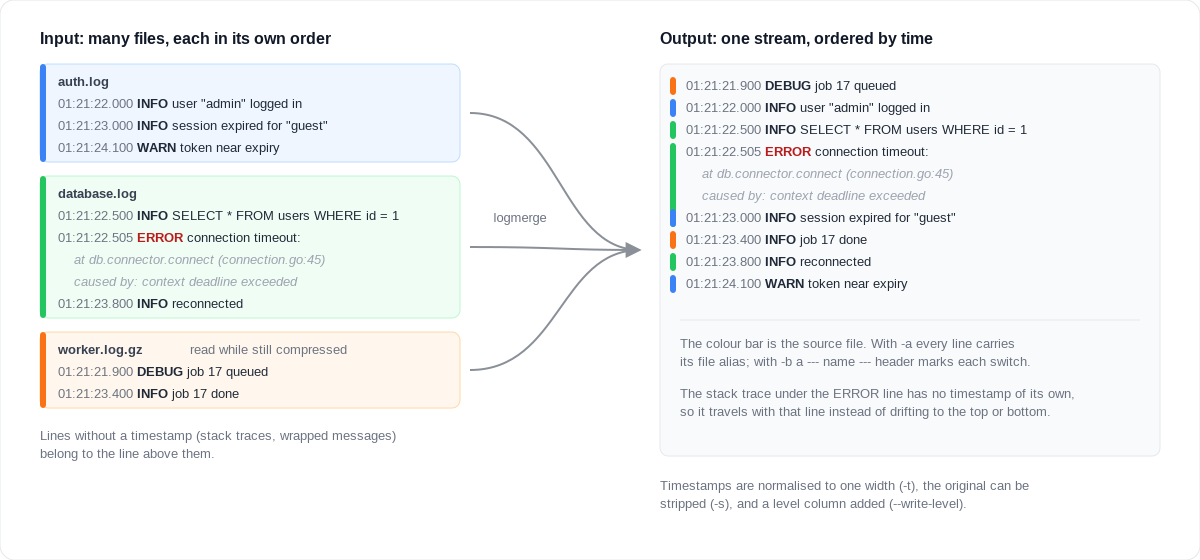
A distributed job leaves its story scattered across a dozen files. Reading them one at a time means reconstructing the timeline in your head. LogMerge writes the timeline.
Point it at anything
Files, directories, globs. .gz, .bz2, .xz, .zip and .tar.* are read in place — no extraction step, and an entry inside an archive is addressable by name.
Timestamps in many shapes
ISO 8601 with T or a space, ctime as syslog and the JVM write it, date-time-millis. All normalised to one width on the way out.
Orphan lines stay put
A stack trace or a wrapped message has no timestamp of its own, so it follows the line before it instead of drifting to the top or the bottom.
Know where a line came from
A per-line alias with -a, or a --- file --- header at each switch with -b; glob-to-name aliases keep long paths short.
Fast enough to forget
A min-heap merge with parallel prefetch, vectorised newline scanning, a branch-predictable parser and an optional profile-guided build (task build-pgo) — nothing allocates per line.
Flags or YAML
Everything is a flag; a YAML file is the base for setups you run often, and flags override it.
How a merge runs
Four stages, and the heap is the whole trick.
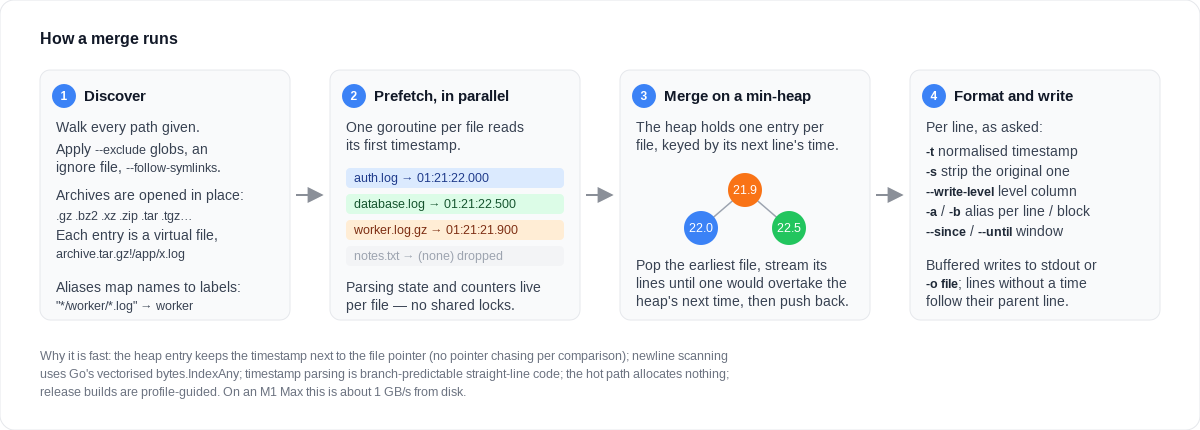
- Discover
Every path is walked, exclude patterns and aliases applied, archives opened in place. An entry inside an archive is a virtual file,
archive.tar.gz!/entry/name.log. - Prefetch, in parallel
A goroutine per file parses the first timestamp so the merge starts with a full heap. Files with no parseable timestamp are reported and skipped; no shared lock anywhere.
- Merge on a min-heap
One entry per open file, keyed by its next line's timestamp, stored beside the file pointer. Pop the earliest, stream it until its next line would overtake the heap, push back — O(log k) per switch.
- Format and write
Timestamp, level and alias prefixes added and originals stripped as asked, the
--since/--untilwindow applied, buffered writes to stdout or a file.
Install
No release yet: build it from source below.
From source with Go 1.26 or newer. Pre-built binaries come with the first release.
From source, then a first run
go install github.com/mmdemirbas/logmerge/cmd/logmerge@latest

logmerge ./logs -o merged.log        # everything under ./logs
logmerge -t -b /var/log/app1 /var/log/app2 | less
logmerge --dry-run /var/log/myapp   # list what would be merged
-t normalises timestamps, -b marks each switch between files. The module path is still …/logmerge; GitHub forwards it to this repository.
What comes out
Interleaved files, a header per block, and the stack trace kept under the line that produced it.
--- auth-service.log ---
2026-03-13 01:21:22.000000000 [INFO] User "admin" logged in
2026-03-13 01:21:22.105000000 [DEBUG] Initializing session cache...
--- database.log ---
2026-03-13 01:21:22.500000000 [INFO] Query: SELECT * FROM users WHERE id = 1
2026-03-13 01:21:22.505000000 [ERROR] Connection timeout:
at db.connector.connect (connection.go:45)
at main.main (main.go:12)
caused by: context deadline exceeded
--- auth-service.log ---
2026-03-13 01:21:23.000000000 [INFO] Session expired for user "guest"
Flags
| Flag | Effect |
|---|---|
-i, --in | Input file or directory; repeatable, added to positional args |
-o, --out | Output file (default: stdout) |
-t / -s | Prepend a normalised timestamp / strip the original one |
--write-level / --strip-level | Add a normalised level column / remove the original token |
-b / -a | Header at each file switch / alias on every line |
--alias glob=name | Name a file or glob; repeatable |
-e pattern, --ignore-file | Gitignore-style excludes; ! negates |
--ignore-archives | Skip .zip .gz .tar .rar .7z .tgz .bz2 .tbz2 .xz .txz |
--since / --until | Keep only lines inside the window (RFC 3339) |
--dry-run, --follow-symlinks | List matched files without merging; follow links while walking |
--config path | YAML file as the base; flags override it |
Feedback
Issues and discussions are public, so an answer given once is there for the next person with the same question.